Regain Direction in Your Career: For Mid- and Late-Stage Leaders

Short on time? Listen to the AI-powered audio version—no scrolling needed.
Even seasoned leaders face uncertainty when teams, organizations, and industries evolve faster than expected. The Career Temporal Alignment Framework (CTAF) helps you map misalignment and take horizon-appropriate action.
Even seasoned leaders have moments when the ground shifts beneath them. You’ve invested in your skills, navigated complex teams, and shaped your career with intention — yet suddenly, the familiar patterns no longer hold. Teams restructure. Systems pivot. Markets and borders evolve. Technology — especially AI — rewrites the playbook almost overnight.
You’re not imagining it.
-
64% of professionals say they feel overwhelmed by the pace of workplace change (LinkedIn News, 2024)
-
69% of workers have changed or considered changing career fields in the past year (FlexJobs, 2024)
This isn’t just a personal experience — it reflects a temporal misalignment between personal growth, team evolution, organizational systems, and the broader ecosystem. When these layers move at different speeds, uncertainty is inevitable.
Why Strategic Career Inflection Points Feel So Hard
Career inflection points — moments when you consider pivoting roles, moving organizations, or launching something new — carry weight because multiple forces are converging at once:
-
Skills are shifting rapidly: Up to 70% of the skills used in most jobs are expected to change by 2030 (LinkedIn Work Change Report, 2025)
-
Technology disruption adds pressure: 34% of workers fear AI may displace jobs in the next five years (FlexJobs, 2024)
-
Teams and organizations evolve unpredictably: Role structures, leadership expectations, and processes can shift on weeks–months or 6–18 month cycles (BCG, 2025)
The result? Even the most experienced leaders can feel destabilized, disoriented, or unsure which move matters most.
The Career Temporal Alignment Framework
To navigate these moments, I developed the Career Temporal Alignment Framework (CTAF) — a research-informed tool that maps where misalignment occurs and where action can be most effective.
How it works: We look at four layers, each with its own pace. These horizons are guidelines, not rigid rules — the key insight is temporal relativity: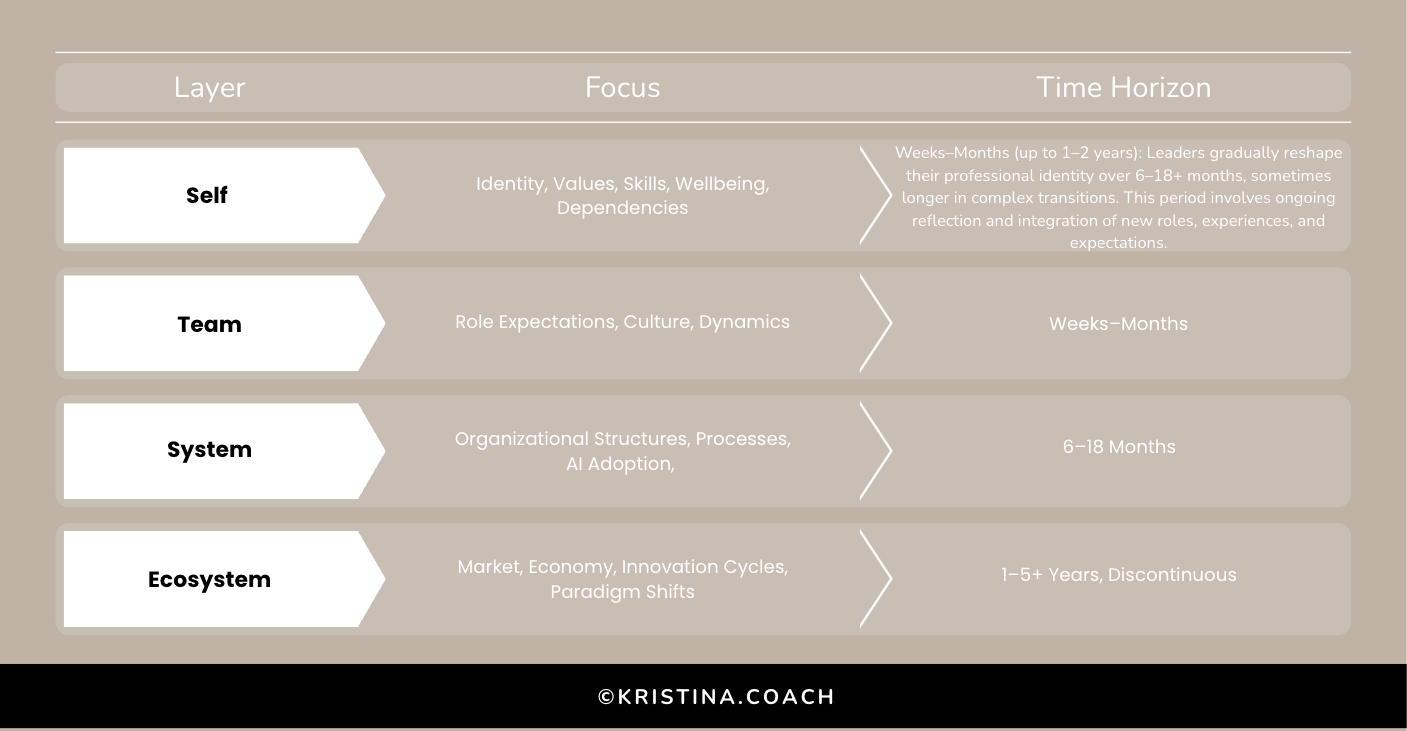
Primary use: guiding leaders through strategic career inflection points — deciding when, how, or whether to pivot their career path.
Secondary/emergent use: addressing decision inflection points within current roles — ensuring decisions are mapped to the pace of the layer that matters most and daily choices support the long-term trajectory.
The Core Insight
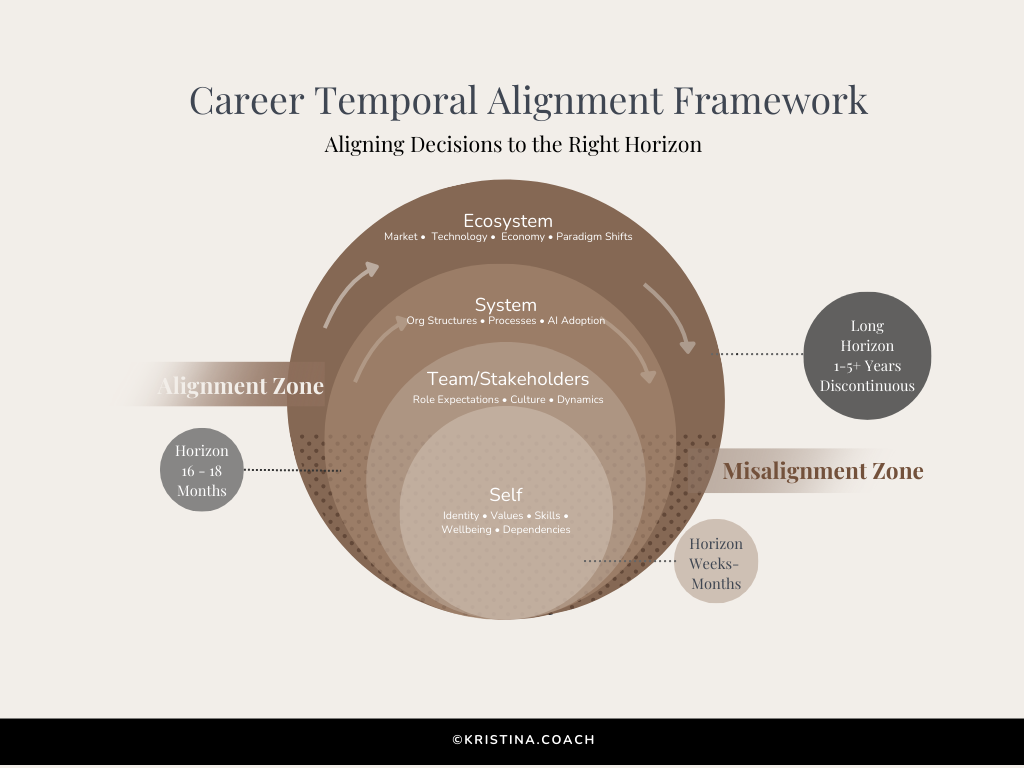
In a VUCA + AI-driven world, misalignment is structural, not personal. Your career uncertainty often comes not from a lack of skill or clarity, but from temporal gaps between layers of influence:
-
Self: Your identity, values, and skills may evolve faster than your Team or System can adapt.
-
Team & System: Role expectations, processes, and organizational structures may move slower or in different directions than your personal growth.
-
Ecosystem: Market shifts, technology disruption, or AI-driven change can occur suddenly, leaving even highly experienced leaders momentarily off-balance.
Recognizing these gaps allows you to:
-
Identify which layer is driving uncertainty
-
Make horizon-appropriate decisions aligned with short, medium, or long-term temporal realities
-
Avoid reactive or misaligned moves that feel urgent but aren’t strategic
Key point: Alignment doesn’t mean controlling every layer simultaneously. It means acting in rhythm with each layer’s temporal reality, making the right moves at the right horizon.
Alignment Zones
What it means: The layer’s pace, expectations, and environment are roughly in sync with your personal identity, skills, and career goals. Decisions here are effective, reinforcing, and well-timed.
Indicators:
-
You feel competent and confident in your contributions
-
Team and role expectations match your personal rhythm
-
Organizational processes support your work, and market trends are manageable and predictable
Examples:
-
Self & Team: Your skills match role responsibilities; team expectations are clear
-
System: Processes or technologies enable productivity rather than frustrate it
-
Ecosystem: Market or sector trends align with your expertise or long-term goals
Time horizon cue: Typically short to medium (weeks–months for Self & Team, 6–18 months for System, 1–5+ years for Ecosystem), but alignment allows each layer to move at its natural pace.
Misalignment Zones
What it means: The layer is out of sync with your trajectory, creating stress, uncertainty, or misdirected effort. The greater the misalignment, the more urgent the need for horizon-appropriate intervention.
Indicators:
-
You feel frustrated, stalled, or reactive
-
Your skills, work style, or contributions are no longer fully relevant
-
Teams, systems, or the broader ecosystem are moving too quickly or too slowly relative to your evolution
Examples by layer:
-
Self → Team: Your capabilities or ways of working exceed what your team expects or can support
-
Team → System: Team dynamics change faster than organizational processes, creating friction
-
System → Ecosystem: Organizational structures lag behind market/technology shifts, making your role ambiguous or risky
-
Ecosystem: AI-driven or economic disruptions make your long-term career trajectory uncertain
Time horizon cue: Misalignment can occur at any layer or horizon. Short-term stress may indicate Self-Team misalignment, while medium or long-term misalignment signals System or Ecosystem gaps. Identifying the horizon helps prioritize which decisions to make now vs. later.
Reflection Prompt
When facing a career inflection point, consider:
-
Which layer is most out of sync with my career aspirations?
-
Where do time horizons conflict — short-term team pressures vs long-term ecosystem shifts?
-
What career-level decision could I make today to restore alignment?
-
Optional: What role-specific decision within my current position could support my larger trajectory?
Even naming the misalignment is a powerful first step toward clarity and confident action.
Applying This in Practice
The framework becomes most powerful in a guided setting, like a Clarity Intensive, where leaders:
-
Map their situation across all four layers
-
Identify horizon-appropriate career or role-level decisions
-
Translate reflection into actionable next steps
Whether your inflection point involves pivoting careers, navigating organizational shifts, or recalibrating your current role, this framework helps you move from overwhelm to insight — and from insight to confident, purposeful action.
Having advised and led inside organizations like PepsiCo, Shopify, Canada Life, and international government entities, I’ve seen firsthand how uncertainty can derail even the most experienced leaders. The Career Temporal Alignment Framework provides a structured, research-informed approach to making complex career choices with clarity and confidence.
Written and edited by: Kristina Mausser
Review generated by: ChatGPT, OpenAi. Revised for clarity.
