The Pace of Change and the Human Work of Leadership

Short on time? Listen to the AI-powered audio version—no scrolling needed.
Why leaders must navigate both progress and the human experience of change
The 1990s are having a moment again.
Music, fashion, and cultural references from that decade seem to be resurfacing everywhere. Beneath the nostalgia, though, there may be something deeper at work.
The 90s were one of the last periods when many people felt like the world was relatively understandable. The pace of change was slower. The signals were clearer. The future felt, if not certain, at least somewhat predictable.
Of course, that memory isn’t entirely accurate.
Toward the end of that decade, the world braced for what became known as Y2K.
As the calendar approached midnight on December 31, 1999, governments prepared contingency plans. Organizations scrambled to audit decades-old code. Commentators speculated about everything from banking failures to power grid outages.
For a brief moment, the stability of the modern world seemed strangely fragile.
In hindsight, the moment now feels almost quaint. The feared catastrophe never materialized in the way many expected. Compared with the pace of technological and geopolitical change today, Y2K reads as a contained moment of uncertainty — a problem that would either happen or not.
But it reminds us of something important: uncertainty about technological change is not new.
What has changed is the scale and the pace at which that uncertainty now unfolds.
Today, many leaders are navigating a very different landscape.
Artificial intelligence is reshaping how work is organized, evaluated, and even imagined across industries. Markets shift quickly. Information travels at extraordinary speed. What might once have appeared in the daily newspaper can now feel outdated within hours.
Organizations often move quickly in response to these shifts. From a strategic perspective, change represents opportunity — the chance to adapt, compete, and remain relevant.
But people experience change differently.
For individuals, change rarely arrives as a purely strategic event. It appears in quieter and more personal ways: uncertainty about what comes next, questions about how roles may evolve, or the uneasy recognition that something familiar may be disappearing.
Even when change ultimately proves beneficial, the process of adapting to it takes time. People need space to understand what the shift means for them and how they will operate within it. And every individual on a team moves through that adjustment at their own pace.
Organizations, however, are rarely structured to move at that pace.
They are designed to pursue progress, innovation, and competitive advantage. Leaders are expected to move initiatives forward, respond to shifting conditions, and make decisions that position the organization for what lies ahead.
In many ways, the work of leadership today lies in holding a tension that rarely resolves: the organization must move forward, while the people within it are still making sense of what that movement means.
Leaders are asked to hold both realities at once.
They are responsible for advancing the work of the organization while also recognizing the human experience unfolding around it — and within themselves.
Because change rarely arrives as an abstract strategic concept. It lands in the middle of careers, ambitions, identities, and relationships.
Leaders sit with the discomfort of disagreeing and committing anyway. They make decisions knowing that not everyone will welcome the outcome. They carry the pressure to respond when events move quickly and expectations shift just as fast.
And there is often a quieter dimension to leadership in moments like this: the recognition that some decisions cannot be shared or delegated. Someone must eventually choose a direction and accept the consequences that follow.
None of this is entirely new.
Periods of transition have always provoked strong human responses. Long before modern organizational theory, people understood that uncertainty activates something instinctive. Our nervous systems respond to perceived threats before our rational minds have had time to interpret the situation.
In that sense, leaders today are navigating dynamics that are deeply human and remarkably familiar.
What has changed is the speed and scope of what surrounds those dynamics.
Where disruption was once largely confined to a single organization or industry, leaders now operate within interconnected systems influenced simultaneously by technology, geopolitics, economic shifts, and cultural change.
Signals arrive from everywhere at once.
Under those conditions, leadership becomes less about finding the perfect answer and more about making sense of what is unfolding — understanding what truly requires attention and what can wait.
That kind of sensemaking rarely happens in moments of urgency. It tends to emerge when leaders are willing to pause long enough to examine a situation from more than one angle, to hold competing interpretations in view, and to resist the temptation to simplify complex problems too quickly.
Clementine Churchill once wrote to her husband Winston Churchill during the immense pressures of the Second World War:
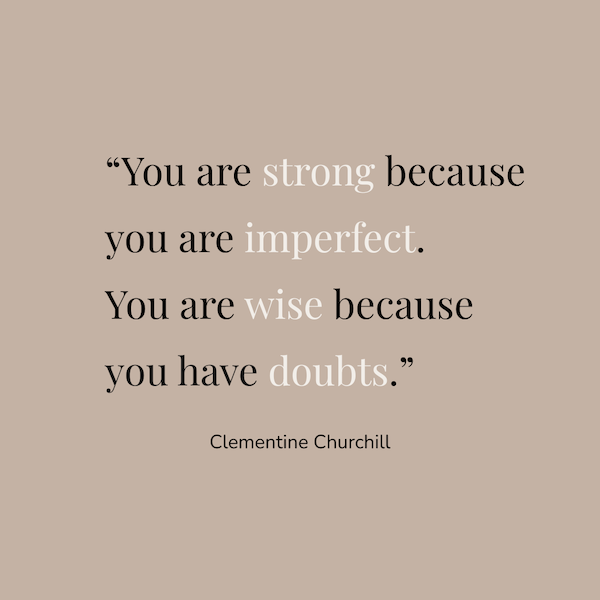
It is a reminder that strength in leadership has rarely meant eliminating uncertainty. More often it involves developing the capacity to remain thoughtful and steady in its presence.
Purpose can become an important anchor in moments like these. So can the recognition that doubt is not always a weakness. Sometimes it is the signal that a situation deserves deeper consideration.
Leaders can also help steady their teams by listening carefully and creating space for people to process change in their own ways and at their own pace.
In environments where everything seems to accelerate, thoughtful listening can become one of the most stabilizing leadership practices available.
Teams are often described as being only as strong as their weakest link. But during periods of change, strength sometimes comes from something different: acknowledging what is being lost, making room for reflection, and recognizing the experience that people already carry.
I remember facilitating a change workshop for a communications team several years ago. Most members of the team were eager to learn new approaches to engagement. The energy in the room was forward-looking and optimistic.
But two members of the team had lived through similar initiatives before.
They were skeptical. They challenged assumptions. They questioned whether this effort would truly be different from previous ones.
Very quickly, the rest of the team began to treat them as obstacles — the negative voices in the room holding progress back.
But the situation was more nuanced than that.
Their skepticism came not from resistance, but from experience.
They had seen similar initiatives unfold before and had learned where enthusiasm sometimes outran reality.
Contexts may change around us — new technologies, new pressures, new expectations — but many of the fundamental dynamics of leadership and collaboration remain surprisingly consistent over time.
Instead of dismissing their voices, the team might have gained more by exploring what those individuals had learned from earlier experiences. Their perspective could have helped the group approach the work with greater awareness rather than repeating familiar patterns.
In periods of rapid change, wisdom often appears in the space between experience and novelty.
Progress rarely comes from rejecting the past outright. Nor does it come from holding on tightly to what once worked.
More often it emerges when leaders are willing to examine both — understanding what still holds true while remaining open to what is genuinely new.
The pace of change may continue to accelerate.
But the human work of leadership remains remarkably consistent: making sense of complicated situations, listening carefully to others, and choosing a direction even when the picture is still incomplete.
And perhaps that is something we can still know.
In environments where signals arrive constantly and expectations shift quickly, leaders often need something surprisingly simple: space to step back and consider what is actually happening around them.
Not to react more quickly, but to understand the situation more fully.
Because the ability to understand what is really happening rarely emerges from the noise of the moment. It grows through reflection, conversation, and the slower work of weighing what truly matters.
Perhaps that is one lesson we might take from those earlier moments of technological anxiety — including Y2K.
The future rarely becomes clearer by reacting more quickly to every signal.
It becomes clearer when people pause long enough to make sense of what is actually unfolding.